

TRANSCRIPT
6 mins 30 secs
Moderate to severe Vasomotor Symptoms, also known as VMS or hot flashes and night sweats, are the most bothersome symptoms of menopause. Growing evidence has led to a different treatment pathway that directly targets a source of VMS in the hypothalamus.
Meet VEOZAH™ (fezolinetant). VEOZAH is not a hormone. It is a first-in-class NK3R antagonist that works differently to directly block a mechanism that triggers VMS.
KNDy neurons in the hypothalamus are inhibited by estrogen and stimulated by the neuropeptide NKB. This balance contributes to body temperature regulation. During the menopause transition, estrogen decline disrupts this balance with NKB. Unopposed, NKB signaling causes heightened KNDy activity and altered activity on the thermoregulatory center, resulting in VMS.
VEOZAH directly targets this source of VMS. By selectively binding to NK3R, VEOZAH blocks NKB, modulating neuronal activity in the thermoregulatory center to reduce heat signaling that triggers hot flashes and night sweats.
It’s time to put the mechanism of VEOZAH to work for your appropriate VMS patients.
INDICATIONS AND USAGE
VEOZAH™ (fezolinetant) is a neurokinin 3 (NK3) receptor antagonist indicated for the treatment of moderate to severe vasomotor symptoms due to menopause.
IMPORTANT SAFETY INFORMATION
WARNING: RISKS OF HEPATOTOXICITY
Hepatotoxicity has occurred with the use of VEOZAH in the postmarketing setting.
CONTRAINDICATIONS
VEOZAH is contraindicated in women with any of the following: • Known cirrhosis • Severe renal impairment or end-stage renal disease • Concomitant use with CYP1A2 inhibitors
WARNINGS AND PRECAUTIONS
Hepatotoxicity
In 3 clinical trials, elevations in serum transaminase [alanine aminotransferase (ALT) and/or aspartate aminotransferase (AST)] levels > 3x ULN occurred in 2.3% of women receiving VEOZAH and 0.9% of women receiving placebo. No elevations in serum total bilirubin (> 2x ULN) occurred. Women with ALT or AST elevations were generally asymptomatic. Transaminase levels returned to pretreatment levels (or close to these) without sequelae with dose continuation, and upon dose interruption, or discontinuation. Women with cirrhosis were not studied.
In the postmarketing setting, cases of drug-induced liver injury with elevations of ALT, AST, alkaline phosphatase (ALP), and total bilirubin occurred within 40 days of starting VEOZAH. Patients reported a general sense of feeling unwell and symptoms of fatigue, nausea, pruritus, jaundice, pale feces, and dark urine. The patients’ signs and symptoms gradually resolved after discontinuation of VEOZAH.
Perform baseline hepatic laboratory tests to evaluate for hepatic function and injury [including serum ALT, serum AST, serum ALP, and serum bilirubin (total and direct)] prior to VEOZAH initiation. Do not start VEOZAH if ALT or AST is ≥ 2x ULN or if the total bilirubin is ≥ 2x ULN for the evaluating laboratory.
Perform follow-up hepatic laboratory tests monthly for the first 3 months, at 6 months, and 9 months after initiation of therapy.
See BOXED WARNING for full hepatic laboratory testing protocol and discontinuation criteria. Exclude alternative causes of hepatic laboratory test elevations.
ADVERSE REACTIONS
The most common adverse reactions with VEOZAH ≥ 2% and > placebo (VEOZAH % vs. placebo %) are: abdominal pain (4.3% vs. 2.1%), diarrhea (3.9% vs. 2.6%), insomnia (3.9% vs. 1.8%), back pain (3.0% vs. 2.1%), hot flush (2.5% vs. 1.6%), and hepatic transaminase elevation (2.3% vs. 0.8%).
Please see accompanying full Prescribing Information, including BOXED WARNING, for VEOZAH (fezolinetant).
6 mins 30 secs
Moderate to severe Vasomotor Symptoms, also known as VMS or hot flashes and night sweats, are the most bothersome symptoms of menopause. Growing evidence has led to a different treatment pathway that directly targets a source of VMS in the hypothalamus.
Meet VEOZAH™ (fezolinetant). VEOZAH is not a hormone. It is a first-in-class NK3R antagonist that works differently to directly block a mechanism that triggers VMS.
KNDy neurons in the hypothalamus are inhibited by estrogen and stimulated by the neuropeptide NKB. This balance contributes to body temperature regulation. During the menopause transition, estrogen decline disrupts this balance with NKB. Unopposed, NKB signaling causes heightened KNDy activity and altered activity on the thermoregulatory center, resulting in VMS.
VEOZAH directly targets this source of VMS. By selectively binding to NK3R, VEOZAH blocks NKB, modulating neuronal activity in the thermoregulatory center to reduce heat signaling that triggers hot flashes and night sweats.
It’s time to put the mechanism of VEOZAH to work for your appropriate VMS patients.
INDICATIONS AND USAGE
VEOZAH™ (fezolinetant) is a neurokinin 3 (NK3) receptor antagonist indicated for the treatment of moderate to severe vasomotor symptoms due to menopause.
IMPORTANT SAFETY INFORMATION
WARNING: RISKS OF HEPATOTOXICITY
Hepatotoxicity has occurred with the use of VEOZAH in the postmarketing setting.
CONTRAINDICATIONS
VEOZAH is contraindicated in women with any of the following: • Known cirrhosis • Severe renal impairment or end-stage renal disease • Concomitant use with CYP1A2 inhibitors
WARNINGS AND PRECAUTIONS
Hepatotoxicity
In 3 clinical trials, elevations in serum transaminase [alanine aminotransferase (ALT) and/or aspartate aminotransferase (AST)] levels > 3x ULN occurred in 2.3% of women receiving VEOZAH and 0.9% of women receiving placebo. No elevations in serum total bilirubin (> 2x ULN) occurred. Women with ALT or AST elevations were generally asymptomatic. Transaminase levels returned to pretreatment levels (or close to these) without sequelae with dose continuation, and upon dose interruption, or discontinuation. Women with cirrhosis were not studied.
In the postmarketing setting, cases of drug-induced liver injury with elevations of ALT, AST, alkaline phosphatase (ALP), and total bilirubin occurred within 40 days of starting VEOZAH. Patients reported a general sense of feeling unwell and symptoms of fatigue, nausea, pruritus, jaundice, pale feces, and dark urine. The patients’ signs and symptoms gradually resolved after discontinuation of VEOZAH.
Perform baseline hepatic laboratory tests to evaluate for hepatic function and injury [including serum ALT, serum AST, serum ALP, and serum bilirubin (total and direct)] prior to VEOZAH initiation. Do not start VEOZAH if ALT or AST is ≥ 2x ULN or if the total bilirubin is ≥ 2x ULN for the evaluating laboratory.
Perform follow-up hepatic laboratory tests monthly for the first 3 months, at 6 months, and 9 months after initiation of therapy.
See BOXED WARNING for full hepatic laboratory testing protocol and discontinuation criteria. Exclude alternative causes of hepatic laboratory test elevations.
ADVERSE REACTIONS
The most common adverse reactions with VEOZAH ≥ 2% and > placebo (VEOZAH % vs. placebo %) are: abdominal pain (4.3% vs. 2.1%), diarrhea (3.9% vs. 2.6%), insomnia (3.9% vs. 1.8%), back pain (3.0% vs. 2.1%), hot flush (2.5% vs. 1.6%), and hepatic transaminase elevation (2.3% vs. 0.8%).
Please see accompanying full Prescribing Information, including BOXED WARNING, for VEOZAH (fezolinetant).
By enrolling in the VEOZAH Savings Program (“Program”), the patient acknowledges that they currently meet the eligibility criteria and will comply with the following terms and conditions: The Program is for eligible patients with commercial prescription insurance and is good for use only with a valid prescription for VEOZAH™ (fezolinetant) at the time the prescription is dispensed by the pharmacy. The Program has an annual maximum copay assistance limit of up to $4,000 per calendar year. After the annual maximum on copay assistance is reached, patient will be responsible for the remaining monthly out-of-pocket costs for VEOZAH. Astellas may reduce or discontinue the copay assistance available under the Program if it determines an enrolled patient does not have an approved claim for VEOZAH. Unless prohibited by law, Astellas may reduce the total copay assistance available under the Program to a maximum of $1,250 for two months (i.e., two 28–31-day fills) if it determines a VEOZAH claim for an enrolled patient is not approved by their commercial health plan. The Program is not valid for patients whose prescription claims are reimbursed, in whole or in part, by any state or federal government program, including, but not limited to, Medicaid, Medicare, Medigap, Department of Defense (DoD), Veterans Affairs (VA), TRICARE, Puerto Rico Government Insurance, or any state patient or pharmaceutical assistance program. Patients who move from commercial insurance to federal or state prescription health insurance will no longer be eligible, and agree to notify the Program of any such change. Patients agree not to seek reimbursement from any health insurance or third party for all or any part of the benefit received by the patient through the Program. This offer is not conditioned on any past, present, or future purchase of VEOZAH. This offer is not transferable, has no cash value, and cannot be combined with any other offer, free trial, prescription savings card, or discount (including any program offered by a third party payer or pharmacy benefit manager, or an agent of either, that adjusts patient cost-sharing obligations, through arrangements that may be referred to as “accumulator” or “maximizer” programs). The full value of the Program benefits is intended to pass entirely to the eligible patient. No other individual or entity (including, without limitation, third party payers, pharmacy benefit managers, or the agents of either) is entitled to receive any benefit, discount, or other amount in connection with this Program. This offer is not health insurance and is only valid for patients in the 50 United States, Washington DC, and Puerto Rico. This offer is not valid for cash paying patients. This Program is void where prohibited by law. No membership fees. It is illegal to sell, purchase, trade, counterfeit, duplicate, or reproduce, or offer to sell, purchase, trade, counterfeit, duplicate or reproduce the card. This offer will be accepted only at participating pharmacies. Certain rules and restrictions apply. Astellas reserves the right to revoke, rescind, or amend this offer without notice for any reason (including to ensure that the offer is utilized solely for the patient’s benefit).
To the healthcare practitioner: By providing this voucher to an appropriate patient, you certify that you understand and agree to comply with the Terms and Conditions below and that you or your office site staff have reviewed the Terms and Conditions with the patient.
Voucher Terms and Conditions: This voucher may be redeemed for a 10-day supply of VEOZAH. Prescription is for the FDA-approved indication. Only new patients may use this voucher. Patients who have previously used or are currently using VEOZAH are not eligible for this voucher offer. A Member ID and a valid prescription from a US-licensed healthcare practitioner must be provided to the pharmacy. Product dispensed pursuant to this voucher cannot be resold or further distributed to any other third party. No claim for reimbursement for product dispensed pursuant to this voucher may be submitted to any third-party payor, including Medicare, Medicaid, or any other federal or state healthcare program. The value of the free product received through this voucher cannot be counted toward any insurance benefit out-of-pocket spending calculations, such as Medicare Part D True Out-of-Pocket (TrOOP) costs. The patient must be 18 years of age or older to use this voucher. This voucher is not valid where prohibited by law. This voucher has no cash value. The selling, purchasing, or counterfeiting of this voucher is strictly prohibited. This voucher is limited to one per patient and is non-transferable. The voucher cannot be combined with any other savings, free trial, or similar offer for VEOZAH. This voucher should not be combined with samples for VEOZAH. This voucher is not health insurance. This voucher is not intended to address delays or gaps in health insurance coverage for the specified prescription. Offer good only in the US. No purchase of VEOZAH or any other Astellas product is necessary. No membership fees. Patients have no obligation to use VEOZAH or any other Astellas product in the future. Astellas reserves the right to rescind, revoke, or amend this offer without notice. For questions, please call 1-800-657-7613.
For eligible patients with commercial prescription insurance
Patients may pay $0 for the first monthly prescription and may pay as little as $30 per monthly refill.*
If a prior authorization is required, it is important to submit your patient’s required insurance paperwork, such as Prior Authorization Form or Letter of Medical Necessity (if applicable) as soon as possible to ensure patients can use the savings card and to help avoid potential delays.
Guide your patients through enrollment. Tell them to visit VEOZAHsavings.com or skip straight to downloading a unique savings card here.
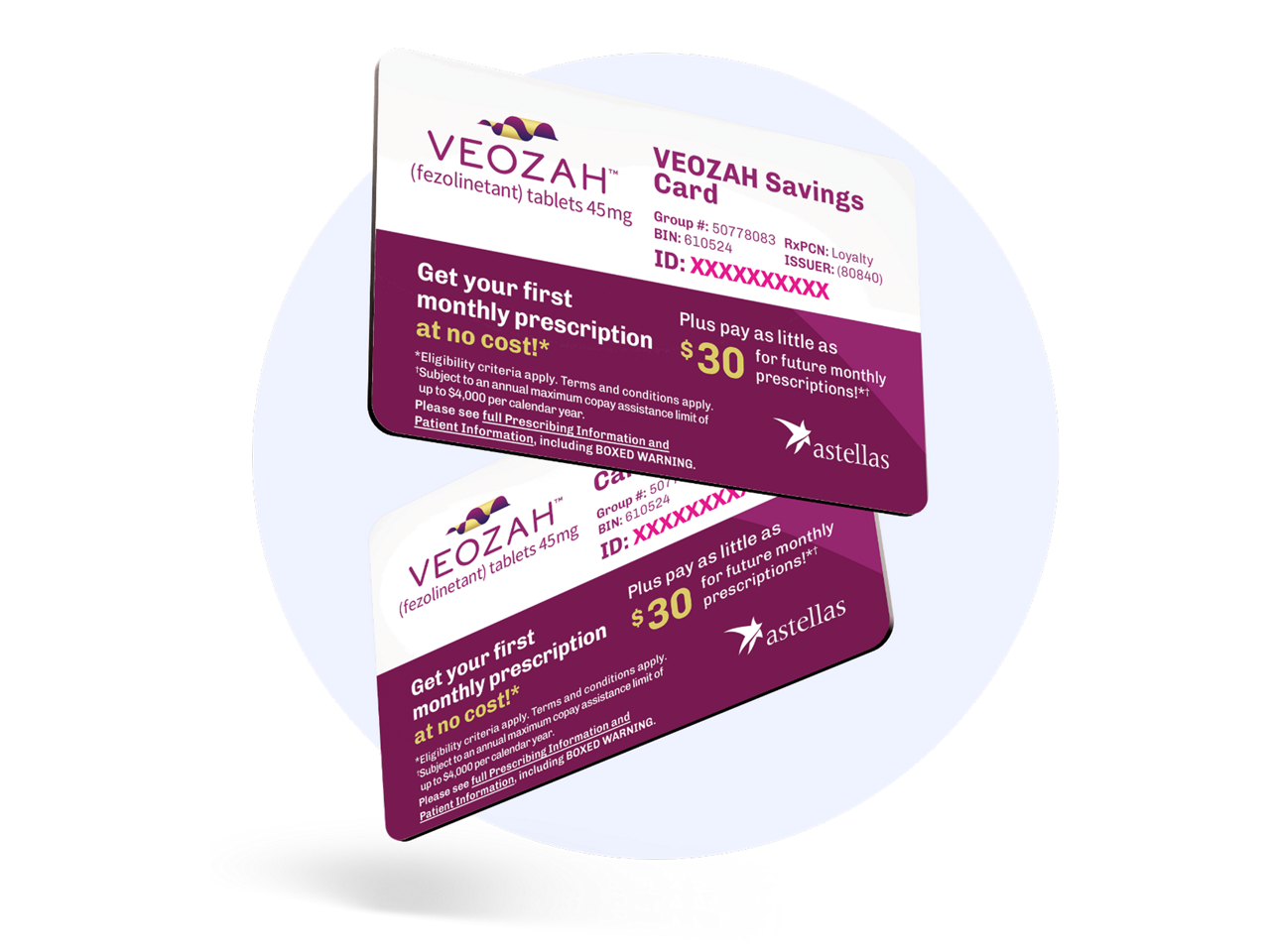
*Eligibility requirements and terms and conditions apply.

*Subject to eligibility restrictions. Program terms and conditions apply. Void where prohibited by law.

Download patient materials, such as the doctor discussion guide.
Find information regarding completing a prior authorization, including checklists and a sample letter of medical necessity. Additionally, you can refer to the list of relevant ICD-10-CM codes.
ICD-10-CM=International Classification of Diseases-10th Revision-Clinical Modification.
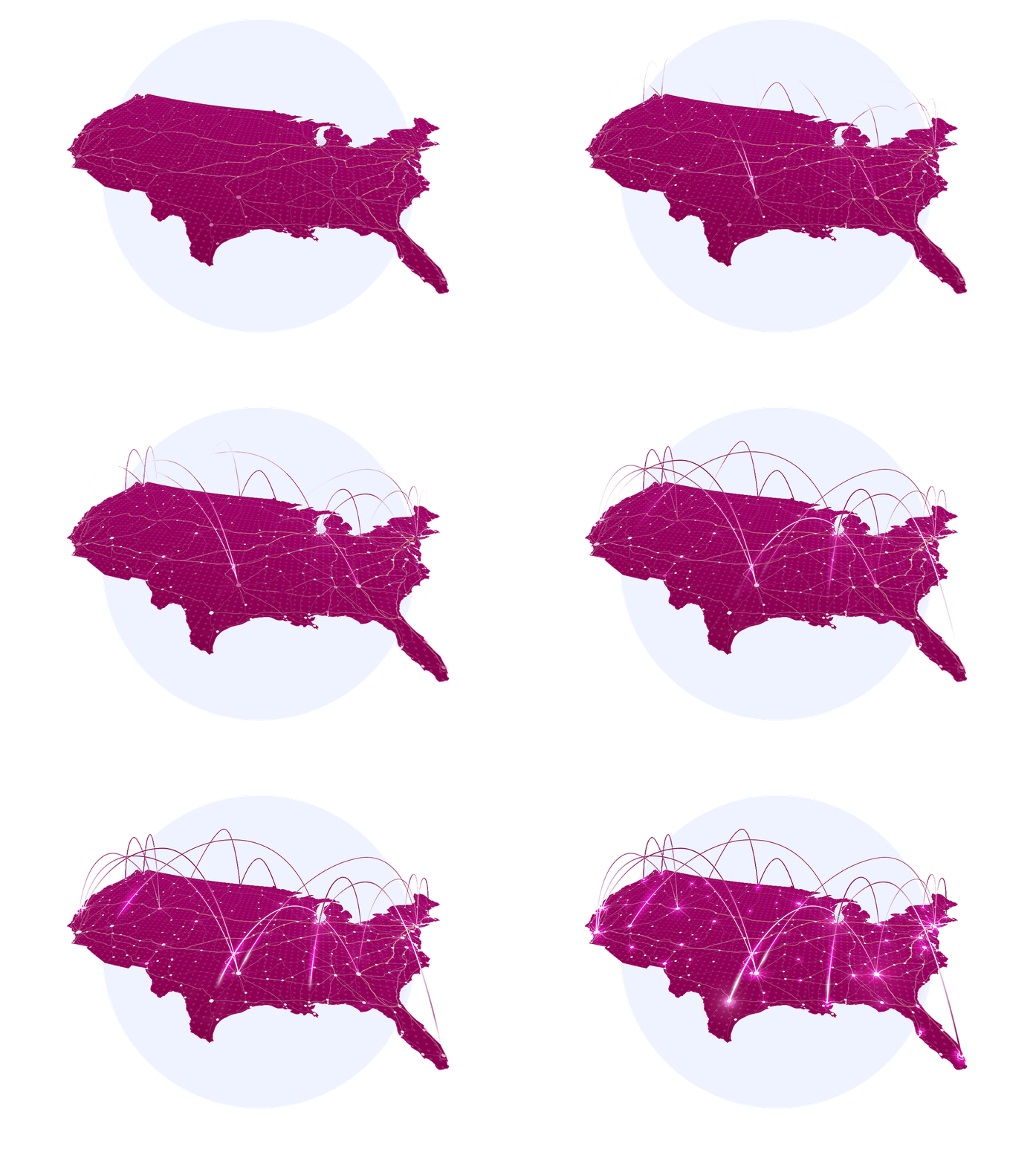
*Data are based on current coverage rates of 65% commercial covered lives as of May 6, 2025 and are not inclusive of Health Exchange. Coverage includes unrestricted and coverage subject to PA and/or step edit.3
FORMULARY STATUS DOES NOT IMPLY SAFETY OR EFFICACY OF ANY PRODUCT. NO COMPARISONS SHOULD BE MADE.
PA=prior authorization.


References:


